~ Pentatonic Scales ~
The Musicarta Pentatonics Workbook
Sample Content Page One for the
Musicarta Pentatonics Workbook
~ now available on Udemy ~
Welcome to the sample content pages for the Musicarta Pentatonics Workbook - now available on Udemy at a discount introductory price of $19.95.
Pentatonic scales have five notes – two of the notes in the ordinary scale are missed out. There are two pentatonic scales, a pentatonic major and a pentatonic minor. These scales are easy to learn and generate lots of music, from blues and heavy metal through to mainstream rock jamming and folk tunes.
You'll recognise the sound of the minor pentatonic scale immediately. Here's an example.
Pentatonic scales are great for improvising because they provide a limited set of notes which sound good over a maximum number of chords. Because there are only five of them, it’s easier to pick a note, and it’s more likely to be a good one.
If you're interested in boosting your popular-styles keyboard skills using this approach, please watch this introductory video.
Here's some sample content from the Musicarta Pentatonics Workbook theory modules.
The all-white-key major pentatonic scales
Musicarta's video method coaches you to reliably finding the pentatonic scale tones in any key. Here are two which use only the white piano keys.
C pentatonic major
F pentatonic major
In fact, the same five keys can make both a major and a minor pentatonic scale. The Musicarta Pentatonic Workbook has lots of diagrams to help you quickly grasp these creative secrets!
Sample Workbook repertoire
Here's 'Ambling Around' - one of the first pieces in the Workbook. It uses the three (C, F and G) all-white-key major pentatonic scales.
Here's the 'One-octave Blues'. It uses the same five keys, but with A as the home-note - so it's in A minor.
Why not try a
free sample Pentatonics Workbook module!
Learn the 'One-octave Blues' (the tune right above).
Click through here to see how easy it is to
...make music with the pentatonic scales!
|
THE PENTATONICS WORKBOOK The immediately recognizable five-tone pentatonic scales are easy to find and underpin much of the popular music we all love. |

|
|
Sample doodles
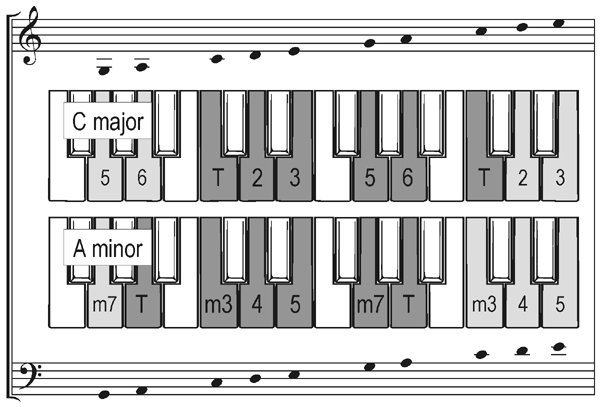
Because the pentatonic scales use only five notes, any note you pick 'sounds right'. That's why they're used so much for melody-writing and improvising.
Here are two sample ‘doodles’. They both start and end on the name-note (tonic/T) of the scale - C or A. They're right in the middle of the keyboard - try to copy them.
C major
A minor
Spoiler alert! Here come 'the answers'!
There's a whole section of playing-by-ear coaching in the Workbook, so don't be dismayed if at first you don't succeed! You can at least see how the two familiar-sounding melodies are made from the notes of the pentatonic scale.
So! Ready to take a leap of faith?
|
THE PENTATONICS WORKBOOK The immediately recognizable five-tone pentatonic scales are easy to find and underpin much of the popular music we all love. |
|
|
Or enjoy your free sample module - The One-Octave Blues.
Thanks for visiting!
By the way...
The Pentatonic Hanon 01-12-20 Exercise Series
The NEW Pentatonic Hanon 01-12-20 Exercise Series has now (Feb 2021) been added to the Musicarta Pentatonics Workbook.
PentHan 01-12-20 coaches you in practicing the pentatonic scales in a way that will build both your keyboard dexterity and the pattern-based creativity present in great improvising.
Click on through to THE SERIES HOME PAGE to get up to speed with this invaluable new resource.
|
OUT NOW! |
THE MUSICARTA BEAT & RHYTHM WORKBOOK At last! An effective approach to keyboard rhythm & syncopation skills. Learn more! |
ONLY $24.95! |


 THE LOGO

|
THE MUSICARTA PENTATONICS WORKBOOK video course Sample pagesThe Videos |
The MusicartaA methodical approach to keyboard syncopation for
|
PUBLICATIONS
exciting keyboard
creativity courses
CHORDS 101
WORKBOOK

~HANON~
video course

Musicarta
Patreon
PENTATONICS
WORKBOOK
video course
Creative Keyboard
video course

BEAT AND RHYTHM
WORKBOOK

- Volume 1 -

12-BAR PIANO
STYLES WORKBOOK
MUSICARTA MODES
WORKBOOK
PIANO STYLE
CANON PROJECT
video course
VARIATIONS
video course
- Piano Solo -
video course
- Piano Solo -
YouTube playlists