Enya Easy Piano
Enya's easy piano style and haunting Celtic melodies are a gift to the 'New Age' piano soloist. Her standard keyboard texture is simplicity itself - read up on it below, watch the MisterMusicarta Enya YouTube videos and play the MIDI files on MidiPiano – you can’t fail to learn these beguiling Celtic gems!
|
Welcome! This is a Musicarta free online piano lesson. If you’re new to Musicarta, please browse the tabs on the navbar, left, to get a feel for what site has to offer, or visit the Musicarta home page for a more detailed overview. If you don’t quickly find what you want, search the site (there’s an index on the Search page as well), or listen to the sample audio files in the Musicarta audio Table of Contents and see if there’s something there you’d like to play. You can also learn more about Musicarta by signing up for the monthly Musicarta newsletter. "Read all about it" on this page! |
Enya easy piano style - with MIDI support
This ‘Enya Easy Piano’ page has MIDI support. To benefit, you need to download the MIDI files and have an application that can play them. Musicarta recommends the ‘MidiPiano’ virtual keyboard - a small, free, reliable application that's easy to download and use.
You can download MidiPiano using this link.
Learn more about playing MIDI files on MidiPiano on the Musicarta MidiPiano web page.
Download the Enya MIDI files here. (The folder also contains annotated chord charts of the YouTube performances.)
Please take the time to download MidiPiano! You only have to do it once, and it will prove a valuable addition to your learning resources. If you need help ‘unpacking’ your zipped MIDI file folder, there are full instructions on the Musicarta MidiPiano page (link, above left) as well.
Note: All Musicarta MIDI files are also available via the Musicarta MIDI file download page. Bookmark it and visit regularly to see what’s new, or subscribe to our RSS feed (orange button, left, below the navbar) and get postings that won’t clog up your email inbox!
A note on the page contents
Musicarta.com's main mission is to nurture your abilities and to turn you from a music consumer to a content creator. Enya’s beguiling melodies and recorded arrangements are ideal for this purpose: if you work through the content of this page, you will have learnt a simple keyboard texture you can use for any chord sequence, whether your own or someone else’s.
The clues about Enya's ‘easy piano style' you will find on this page, however, are no substitute for the full piano score, which you can easily purchase on the web or at your local sheet music shop.
The audio performances and Musicarta YouTube channel videos are strictly ‘how-to’ quality and no substitute for the CDs as a listening experience, while the MIDI files are bald mechanical versions of personal score writing programme transcriptions, offered, like the videos, only in order to show how hand placement and chord sequence are related.
We pianists owes a great debt to Enya and her collaborators Nicky and Roma Ryan for bringing such sweet, playable music into the world. This web page is a homage to them.
Here are the four Enya solos dealt with on this page. The tiles below the audios will take you to the individual solo sections.
An easy piano texture
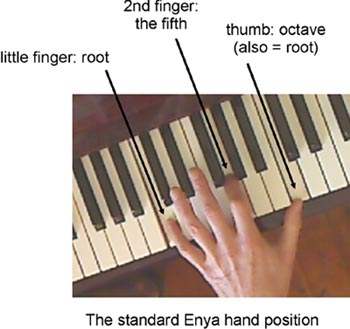
Enya sets up her basic texture by rocking a three-note left hand chord consisting of the root, fifth and octave.
- If you put your left hand little finger on the note named in the chord symbol, you’ve got the root.
- If you put your thumb on the next chord symbol name-note up, you’ve got the octave.
- Your second finger will probably fall right over the fifth just naturally.
Enya plays these notes up and down, giving a basic four-quaver set which can be moved around anywhere.
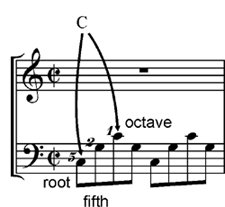
(The music and the hand in the photo match up.)
The beauty of this is, both the left hand little finger and thumb play the note named in the chord symbol most of the time, so you can easily play from a chord chart.
What the right hand does
The three notes of the Enya left hand texture are easy to find, but, on their own, they sound rather ‘bald’. They lack the ‘sweet’ chord tone – the third. In Enya’s style, the third usually appears in the right hand as the melody note with the first of the four left hand quavers.
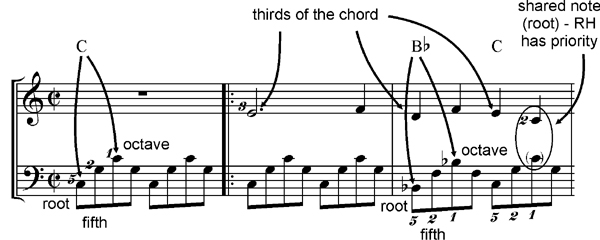
The music sketches out a basic performance of No Holly For Miss Quinn.)
But you can’t have melodies using only the third, and from time to time the right hand plays the root - the same note that the left hand thumb needs to play. You have to share the note – and the melody (right hand) has priority, of course.
You can see clearly where this happens if you play the MIDI file of No
Holly For Miss Quinn on MidiPiano. Watch the video
closely at these points to see how to manage your hands.
No Holly For Miss Quinn
Watch the video.
There’s an annotated chord chart pdf of the YouTube performance in Enya MIDI file folder you've downloaded. Try to follow as you watch the video.
With the chord chart, the explanations on this page, the video and the MidiPiano performance, you only need to pick out the melody - by ear or just copying - to get the solo into your repertoire.
| Listen to Enya's original version on her ‘Shepherd Moons’ CD (various issuers) for inspiration and performance ideas. Get the full piano transcription, published by Hal Leonard (HL.308133). |
From Where I Am
Here's the video.
Very similar in texture to No Holly For Miss Quinn, but the left hand misses out quite a few of the left hand quavers, leaving gaps, usually where the right hand plays.
There's quite a variety of phrase lengths in the piece. Listeners don’t usually register odd phrase lengths consciously (unless you're analyzing the piece – to write the chord sequence down, for exanple!) – but the unnoticed ‘a bit out of the ordinary’ quality keeps the interest up.)
Note that the MIDI performance clips are only for finding the notes and organising the hands – they have no rubato (tempo elasticity) at all, which is central to Enya’s style. Consciously imitate the ‘stretchiness’ of the original CD performances.
Lothlorien
Here's the Mister Musicarta YouTube video.
Note the structure: A B A B A B – with the usual extended ending. The left hand texture of each repetition is however slightly different (to keep the interest up); so A1 B1 A2 B2 A3 B3 would be more accurate.
Watch the tricky counting:
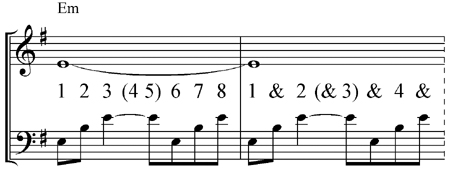
The first bar is counted in quavers, the second in crotchets (more correct). Listen out for this rhythm in the performances and practice the counting – it’s hard not to rush the bars where this happens.
Ladders
('flip') The standard Enya left hand pattern plays the root, fifth and octave (R–5–O) but the hand can easily invert upwards and play the fifth, the octave (= root), and another fifth above that (5–O–5), so:
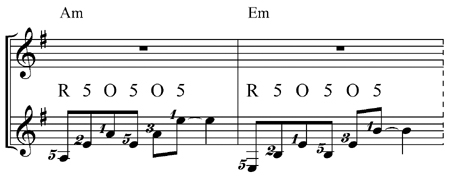
Musicarta calls this climbing arrangement of roots and fifths a 'ladder', and the four Musicarta Enya arrangements you've been listening to use them as endings.
Pay close attention to the fingering as the hand crawls across the keyboard sireways. Notice the middle finger changes from 2 to 3 in the new fifth-octave-fifth position. If you don’t change the finger, you’ll probably play the wrong middle note here.
|
Watch the Musicarta Enya easy piano videos here
|
Download the Enya MIDI files and chord charts here.
|
Watermark
Watch the video first.
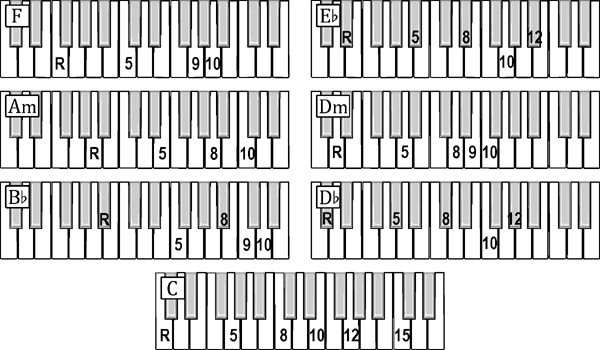
The key to learning this piece is understand the handful of left hand patterns used in the accompaniment. Only one of the patterns is used for more than one chord.
For example, for every F chord the left hand plays:
- root, fifth, ninth, tenth, ninth, fifth,
but for the A minor chord, you play:
- root, fifth, octave, (minor) tenth, octave, root .
You can see that in the MidiPiano performance of your MIDI download file.
Here's your final crib sheet, showing the tones used in the six patterns. You need to learn them by heart first, and use the chord chart to help you play the piece.
Taking it forward
This Musicarta Enya page aims to show you how to get four lovely Enya songs into your repertoire - but also to demonstrate that a simple keyboard texture can generate lots and lots of wonderful music.
In fact, Musicarta is a keyboard creativity site – not so much about “Play this by so-and-so” as “Listen to this – it’s by ME!”
It’s easy to improvise and compose using the keyboard texture demonstrated in this material – if you’re prepared to make a few mistakes and ‘push on through’!
Now, there's a whole Musicarta digital study pack dedicated to making you the master of this easy piano style...
|
MUSICARTA EASY The Musicarta Easy Piano Style shows you how to get your hands on the keys and start making music right away! With lots of graphics, full audio and MIDI support and all the solos on the Mister Musicarta YouTube MEPS video playlist, you’re sure to get some beautiful pieces into your repertoire quickly – and learn how to find the music in the keyboard for yourself. |
|
Each workbook module demonstrates a different way of developing the basic material. There's always a simple version you can get into you can-do ‘bag of tricks’ while you work on more advanced skills.
All the module studies have performance videos which are collected on the MMYT Musicarta Easy Piano Style MEPS playlist.
As well as these attractive solos, the Musicarta Easy Piano Style (MEPS) package invites you to learn the simple building blocks, then ‘doodle’ them into something all your own.
Make Musicarta your creative keyboard companion and become a composer today! Click through to the MEPS series home page for a closer look at the study course contents.
If you enjoy playing this style of piano playing, you're sure to enjoy the piano solos in this collection - most of them were composed at the keyboard using the Musicarta Easy Piano Style.
|
PIANO SOLOS Piano Solos Volume 1 is a collection of eleven solos from across the Musicarta spectrum. Each solo has a couple of pages of notes explaining how the music is put together and offering useful practicing advice. Easy-inter to inter-advanced solos with audio and MIDI files and player and a 50-page PDF (A4/US Letter). |
|
You can browse the contents in detail on the Musicarta Solos web page and the video performances are gathered together on the Mister Musicarta YouTube Solos playlist.
The latest release from Musicarta Publications...
|
The MUSICARTA The modes are known as scales for improvisation – and for generating intriguing chord sequences not available in the conventional major/minor key system. Here is a methodical, ‘lean’ approach to building a sound and productive knowledge of modes for the modern-styles keyboard player, packed with riffs which will expand your chord vocabulary and your repertoire of rhythmic keyboard skills. |
|
Most of Enya's music is modes-based - so check out those playlists!
Musicarta teach-yourself piano solos
There are two slightly more advanced Musicarta piano solos - featuring the signature Musicarta 'left-hand-over' style - which come in both the full teach-yourself digital download and sheet music 'lite' versions.
|
‘MARIAAN’ Piano Solo Playing a melody plus its own full, satisfying chord accompaniment is THE benchmark achievement for the modern-styles keyboard player. ‘Mariaan’ builds just such a performance, step by step – and with no-one left behind. Guaranteed to expand your creative horizons every time you sit down to work at it! |
| ||
|
Click through to the ‘Mariaan’ YouTube playlist
Now available! 'MARIAAN Lite' Just the music - no teaching notes, audio or MIDI. Chord Study, Mariaan, Mariaan 2.0, four lead sheets, 28 pages A4. |
Only
|
|
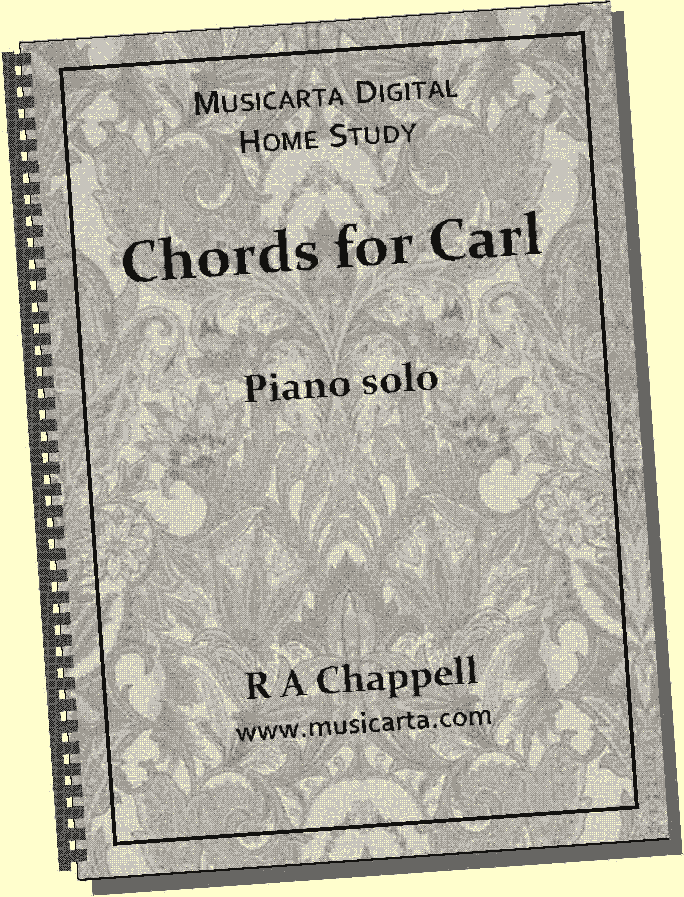
'Chords for Carl'
Now a fully video-supported approach to keyboard chord texture and building a full modern solo performance, this unique teach-yourself opportunity shows you only what you need to know and exactly how to learn it. |
| ||

Got a newsletter discount code? You want the discount sales page!
There's a fun MMYT 'Left hand over style' playlist too!
Musicarta Celtic piano improvisations
Here are a couple of Musicarta piano solo performances in the Celtic style which haven't made their way into Publications yet. Watch the videos - you'll see that they use the left hand root-fifth-octave accompaniment, but played OVER (literally!) the the right hand melody. (You have to keep your right hand quite flat, but it;s a nice trick to get and generates a unique instrumental sound.)
Just released (April 2015)
Syncopated, two-handed rhythms at the keyboard are not easy, but with the right teacher, everybody can be much better at syncopation than they ever thought possible!
The Musicarta Beat and Rhythm Workbook can be that teacher. With dozens of online audios to copy and desktop coaching videos courtesy of MidiPiano, you can’t fail to make stellar progress.
In a rockier vein...
|
The MUSICARTA 12-BAR PIANO STYLES WORKBOOK Twelve-bar is some of the easiest popular music you can make, and its irresistible rhythms and momentum have long made it an acknowledged and much-loved nursery school for keyboard improvisation. The twelve bar chord sequence makes simple soloing effective and attractive while, at an advanced level, blues soloing merges seamlessly into jazz improvisation. |
|
(...in case you're feeling all New-Aged out!)
Other Musicarta home study downloads
There are three other Musicarta digital home study packs designed to structure your efforts, maximize your progress at the keyboard and give a boost to your creative music-making,
Each package comprises:
- An illustration-rich PDF workbook of around 120 pages;
- The
audio and MIDI files for all the musical examples; and
- The MidiPiano application, to play the MIDI files. (See individual product specs for variations.)
These are the three Musicarta keyboard creativity downloads.
|
The PYRAMIDS VARIATIONS The Musicarta Pyramids Variations aims to exceed expectations by coaching beginners and re-starters to an impressive ‘Concert Performance’ in just eight lessons. After that, you learn a set of variations which model all the contemporary keyboard player’s knowledge and skills. |
|
Click through to the Pyramids Variations YouTube playlist here.
The Pyramids Variations is another chord shape-based intro to making music from scratch. This time it's Musicarta's 'Basic Music-Making Position' (- two root position triads for the theory-savvy).You learn a graded series of variations on a simple chord sequence right up to an impressive Concert Performance - then go on to explore the creative potential of your achievement in a series of attractive Variations..
Inquire further at the series home page, and check out the MMYT playlist.
|
The CANON PROJECT Pachelbel’s Canon in D is perhaps the most famous chord sequence of all time, and the basis of dozens of popular hits. If you can play and understand the Canon chord sequence, there isn’t much in popular music harmony you won’t be able to figure out! Its regular structure also makes it a great springboard for improvising and composition. |
|
Amazon Books also available Udemy
Click through to the Canon Project YouTube playlist here
The chord sequence of Johann Pachelbel's beautiful Canon in D is virtually the mother of the pop ballad - anyone who can play it and understand is already half-way there. The left hand uses chord tones familiar from Pyramids and MEPS.
Browse the contents on the series home page, and check out the MMYT playlist.
Musicarta Key Chords takes a slightly different tack. It builds your chord vocabulary by introducing and drilling the chords you're most likely to find in any key and in any piece of music - and in modern syncopated riffs with full rhythmic build-up exercises.
Check out the series home page and the MMYT playlist for a closer look at the contents.
Musicarta home study digital downloads offer anyone wanting to learn modern popular keyboard styling THE best opportunity to structure there efforts and maximize their gains. Buy now and get started! You're bound to come away with something - and for less than the cost of a single piano lesson!
|
OUT NOW! |
THE MUSICARTA BEAT & RHYTHM WORKBOOK At last! An effective approach to keyboard rhythm & syncopation skills. Learn more! |
ONLY $24.95! |


 THE LOGO

The MusicartaA methodical approach to keyboard syncopation for
|
PUBLICATIONS
exciting keyboard
creativity courses
CHORDS 101
WORKBOOK

~HANON~
video course

Musicarta
Patreon
PENTATONICS
WORKBOOK
video course

Creative Keyboard
video course

BEAT AND RHYTHM
WORKBOOK

- Volume 1 -

12-BAR PIANO
STYLES WORKBOOK
MUSICARTA MODES
WORKBOOK
PIANO STYLE
CANON PROJECT
video course
VARIATIONS
video course
- Piano Solo -
video course
- Piano Solo -
YouTube playlists