FREE PIANO LESSONS ONLINE
The Pyramids Variations
A few quick questions...
Have you ever said to yourself, “I wish I’d never given up the piano!”?
Have you ever said, “I’d love to be able to sit down and ‘just play’ …”?
Have you ever wished you could play chords as easily as a guitarist?
Well, if you can find this
'basic music-making position'
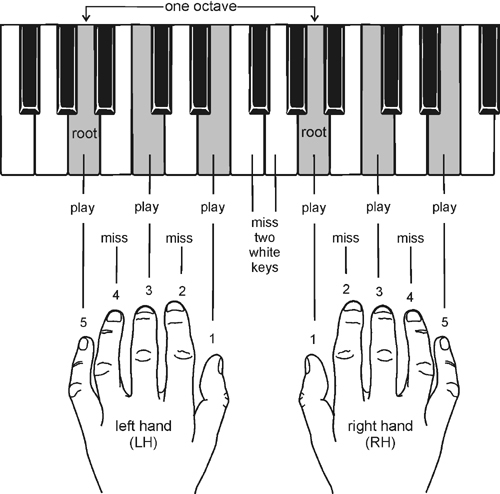
... you can easily
- Take up the piano again!
- 'Just sit down and play’!
- Learn to play chords from chord symbols like a pro!
... and you can do all this at home with the
Musicarta Pyramids Variations
Part One of the Musicarta Pyramids Variations is a tailor-made series of piano lessons online which fast-tracks any committed keyboard player to this Pyramids Variations ‘Concert Performance’ in just eight progressive lessons.
Here's a video of the Lesson One performance.
And here's a video of the Lesson Eight grand 'Pyramids Variation Concert Performance'.
You can play like that - even 'starting from scratch'. Here's how!
|
The PYRAMIDS VARIATIONS The Musicarta Pyramids Variations aims to exceed expectations by coaching beginners and re-starters to an impressive ‘Concert Performance’ in just eight lessons. After that, you learn a set of variations which model all the contemporary keyboard player’s knowledge and skills. |
|
Click through to the Pyramids Variations YouTube playlist here.
Fast-track build-up - a new way to learn
Learning the piano the old-fashioned way is slow, because you can only play the music you can read. The Musicarta Pyramids Variations piano lessons online guarantee lightning progress by turning this formula on its head.
Using text, illustration, audio and MIDI support files and video, you learn to play the music-at-the-keyboard, with the written-out music only there as a reminder (and for conventionally trained pianist who are joining the programme to develop their musical creativity!)
Every lesson in the build-up adds a little to what went directly before – there are no big surprises and no yawning gaps. The result is that you can build up to an impressive performance much faster than you could with conventional teaching.
And, unlike conventional piano-piece learning, where you have to master a whole piece to produce a performance, with the Pyramids Variations onine piano lessons you always come away with a piece you can play. Each build-up stage stands as a performance in its own right - much more satisfying and encouraging!
Listen the these build-up audio clips
This series of audio clips demonstrates the build-up to the Concert Performance in Part One of the Pyramids Variations. Listen to the clips one after the other straight through – you can hear how each module builds on the one before, making learning the Concert Performance in just eight steps easily achievable.
If you'd like to see what these performances look like, browse the sample pages in the right-hand series navigation table, or watch a non-stop run-through on this MisterMusicarta Build-up playlist.
First, you learn how to use the Basic Music-making Position to play chords at the keyboard, and how to use chord symbols to find the eight chords in the Pyramids chord sequence. Here’s what your Lesson One performance sounds like:
Here's a video of how Lesson One works in practice
Watch it on Mister Musicarta YouTube
In Lesson Two, a simple left-hand-over technique adds an introduction and an ending, making this pretty chord study:
In Lesson Three, you use your knowledge of chords to find the notes to use for a melody. Adding just one note per bar to your Lesson Two performance turns your chord piece into this great little solo:
The Basic Music-making Position lets you play chords up and down the keyboard freely. Add your eight melody notes and by the end of Lesson Four your Pyramids performance will be sounding like this:
In Lesson Five, you develop the melody using in-between notes you’ll find right under your fingers:
Is this all sounding a bit too ‘classical’ for your liking? Don’t give up on Pyramids just yet! Here’s a taste of a funkier version from the ‘Variations’ section, later:
The four-section ‘AABA’ song form lies at the heart of thousands and thousands of popular tunes. You only need to apply your keyboard texture to the three new chords to expand you performance into this Lesson Six performance:
In Lesson Seven, you expand the new music to four-chord status:
…and you’ve learned all the components of the Pyramids Concert Performance:
|
The PYRAMIDS VARIATIONS With website audio and video support, the Pyramids Variations provides methodical support for your creative journey, offering pianists of all ages and stages fast-track guidance to a performance beyond expectations and a practical, step-by-step introduction to 'composing at the keyboard'. |
|
Click through to the Pyramids Variations YouTube playlist here.
Don't read music? Not a problem!
With the Musicarta Pyramids Variations, you don’t have to read music to make swift progress. Everything you have to do is explained, with illustrations (more than 1,000 in the pdf!), and all the written-out music examples have accompanying sound clips and MIDI files that you can play on MidiPiano (Windows OS) or Synthesia – so you can see-and-hear exactly what you’re supposed to be doing. (MidiPiano can even slow down playback, so you’re bound to be able to play along!)
Here's the Pyramids Variations Lesson Two MIDI file played on MidiPiano
MidiPiano is small, easy to use, and has invaluable educational features. Note that there’s no delay waiting for video to buffer when you use MidiPiano to play the Pyramids Variations MIDI files on your own desktop.
In fact, the Pyramids Variations is a great way to learn to read music without having to use beginners’ books – and going back to beginners’ pieces! Your download includes twenty-six videos showing module performances playing on the MidiPiano keyboard while the written-out music scrolls across above. Here’s the MidiPiano-plus-scrolling-music video for Lesson Three, where you add the melody notes on top of the chords.
With all that help, it won't be long before you starting seeing how the written represents what you can already play and this Concert performance music
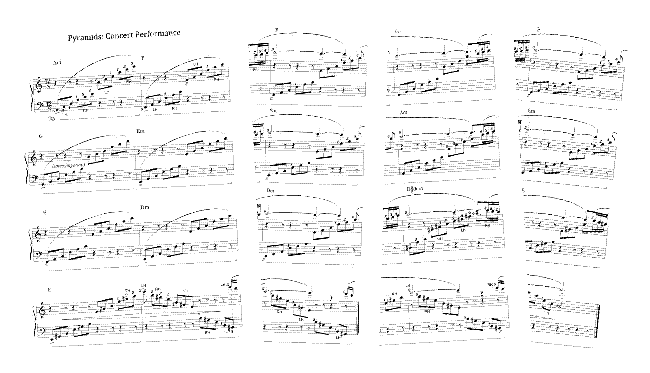
- ... won't frighten you a bit!
|
The PYRAMIDS VARIATIONS Home-study download comprising a 150-page PDF, 200-plus MIDI files of the musical examples and a free ‘virtual keyboard’ MIDI file player. Study online with audio files of all examples and 50-plus how-to videos. A comprehensive creativity booster for every keyboard player. |
|
Click through to the Pyramids Variations YouTube playlist here.
And then what?
Once you’ve completed the eight lessons which build up to the Concert Performance and have a good grasp of the ‘harmonic material’, the Pyramids Variations offers you the opportunity to move forward into improvising, composing and ‘just playing’ by showing you how you can play the Pyramids chord sequence in many different ways.
Variations are a great model of keyboard creativity in action – playing a dozen variations on one chord sequence will teach you a lot more keyboard creativity than playing a dozen different chord sequences.
And because you know the Pyramids chord sequence so well, you’re able to practise creating music by combining and varying slightly the familiar building blocks – practical knowledge you can apply to any chord sequence going forward.
Here are some of the variations on the Pyramids chord sequence you learn in the second half of the Pyramids Variations.
Developing the Bass Line
Melodies usually move between chord tones via a series of non-chord in-between notes. The first module in the Variations section teaches you to think like a composer by taking a close look at what actually happens between the main anchor notes.
Mixed Inversions
The Pyramids chord sequence is custom-made to give you the maximum musical return on your investment of time and effort. For example, raising the top of one chord conveniently produces an inversion of the next chord in the sequence. Easy, but sounds good!
Descending Variations
The Pyramids Variations repeatedly shows you how to combine things you know in new ways to produce lots of new music relatively easily. These Descending Variations turn the mixed inversions upside down and put the melodic patterns from the Developing the Bass Line module at the top.
Pyramids in Four-four Time
The six notes in the Basic Music-making Position make six-eight the obvious time signature, but it has quite a ‘classical’ feel. This module takes our chord sequence into the more rock-sounding four-four time sequence, with in-depth instructions for this attractive 3+3+2 quaver pattern.
Circle of Fifths
Any self-respecting ‘muso’ has to know about the circle of fifths! By adjusting just three bass notes, you can turn the Pyramids chord sequence into a circle of fifths chord sequence and play it until you know the circle of fifths by heart.
Further Variations
The Pyramids Variations ends with a springboard round-up of ideas and possibilities – examples of the treatments you could use on any song or chord sequence.
Here are a couple of examples – perhaps you can already start to hear how the familiar building blocks are being re-combined!
The music theory you will learn
Working through the Pyramids Variations will teach you the practical and theoretical aspects of:
- Finding chords and naming them
- Building major and minor chords
- Understanding chord symbols
- Forming inversions of chords
- Adding a chord-tone melody to an accompaniment
- Developing melodies and bass lines with non-chord tones
- Playing a chord sequence in various time signatures
- Understanding 16 and 32-bar song form
- Using suspensions and ‘slash chords’ to enhance chord sequences
- Playing sophisticated seventh chords
- Playing from a lead sheet
- Syncopation and anticipation
The Pyramids Variations brings music theory alive by showing you how to play attractive music which demonstrates each element in turn. You build your theoretical knowledge in step with your performance, in a way which will allow you to use it creatively going forward.
|
The PYRAMIDS VARIATIONS Building major and minor chords, understanding chord symbols, forming inversions, seventh chords, suspensions and ‘slash chords’, song form, syncopation and anticipation, playing a chord sequence in different rhythms – a practical, hands-on introduction to essential music theory. |
|
Click through to the Pyramids Variations YouTube playlist here.
What exactly is the Pyramids Variations?
The Musicarta Pyramids Variations consists of:
- A 150-page PDF file, professionally formatted with navigation links and print-ready.
- Audio and MIDI files for the 200-plus musical examples in the PDF file, arranged and referenced for efficient studying. The audio files are in MP3 format which will play on virtually all media players.
- A free Windows-platform ‘virtual keyboard’ called MidiPiano to play your example MIDI files. (Piano-style MIDI file players for other operating systems are readily available.)
- Twenty-six videos showing all the main performances playing on the MidiPiano virtual keyboard with the written-out music scrolling across in sync.
How do I get it?
The Musicarta Canon Project is available as an internet download. The
download version is securely hosted with E-Junkie, a reputable and
long-standing service provider.
- What happens when I press the download ‘Buy now!’ button?
You will be taken to E-Junkie’s check-out page where you can pay using your PayPal account or your regular credit card.
Once your payment has gone through, you will be sent an email with your secure download link. YOUR SUCCESSFUL DOWNLOAD IS GUARANTEED! You have five attempts and twelve hours to get your download. If you experience difficulties, contact Musicarta via webmaster@musicarta.com.
NOTE:. To avoid frustration, you should temporarily disable any ‘accelerated download’ toolbars you might have installed, and try to download outside peak traffic hours.
What do I need to learn?
To build your keyboard creativity with the Musicarta Pyramids Variations you only need:
- A piano or keyboard – and some persistence!
- A computer with a PDF reader and a media player. Audio files are in MP3 format, download videos MP4.
- The MidiPiano virtual keyboard (Windows OS, included in the download) to play your MIDI files. (Non-Windows alternatives are available.)
You do not need to be able to read music, or to have any special computer skills or know-how – you play MIDI files on MidiPiano exactly the same as audio tracks in your media player.
A creative syllabus for classically trained pianists
Do you want to leave written music behind and let your creativity out of the box? The Pyramids Variations is packed with new ways of understanding music which will develop your musical creativity. The many illustrations and a structured approach to memorising both the music and the ‘underlying structures’ like the chord sequence, song form and keyboard texture, will help classically trained pianists and adult re-starters break free of written music and start to see the ‘music in the keyboard’.
The Pyramids Variations for teachers
The Pyramids Variations provides an ideal creative supplement to conventional piano lessons.Teachers can familiarise themselves with the content of the modules one at a time and use them as a ‘script’ for a manuscript-free lesson segment.
Coach pupils to a performance well beyond their expectations and put them on a structured programme of ‘really useful’ music theory at the same time! Teachers can decide on an individual basis how much of the related theoretical background to present.
|
The PYRAMIDS VARIATIONS With website audio and video support, the Pyramids Variations provides methodical support for your creative journey, offering pianists of all ages and stages fast-track guidance to a performance beyond expectations and a practical, step-by-step introduction to 'composing at the keyboard'. |
|
Click through to the Pyramids Variations YouTube playlist here.
It’s a living thing!
The Pyramids Variations will continue to be actively supported and developed at Musicarta. Checkout the Musicarta TPV Diaries YouTube channel regularly for new and inspiring material!
Purchasers of The Pyramids Variations will receive free download links for new material as it becomes available. Coming back to material like this is a great opportunity to deepen your understanding of what really makes music tick.
Now check out the lesson-by-lesson build-up using the right-hand column series - or just start here and follow the bottom-of-page links to see how you could soon be playing an impressive piano solo and start learning how to improvise yourself.
|
OUT NOW! |
THE MUSICARTA BEAT & RHYTHM WORKBOOK At last! An effective approach to keyboard rhythm & syncopation skills. Learn more! |
ONLY $24.95! |


PYRAMIDS
|
The MusicartaA methodical approach to keyboard syncopation for
|
PUBLICATIONS
exciting keyboard
creativity courses
CHORDS 101
WORKBOOK

~HANON~
video course

Musicarta
Patreon
PENTATONICS
WORKBOOK
video course

Creative Keyboard
video course

BEAT AND RHYTHM
WORKBOOK

- Volume 1 -

12-BAR PIANO
STYLES WORKBOOK
MUSICARTA MODES
WORKBOOK
PIANO STYLE
CANON PROJECT
video course
VARIATIONS
video course
- Piano Solo -
video course

- Piano Solo -

YouTube playlists