The Musicarta Canon Project
Canon in D piano
Working with Musicarta, your unique Canon in D piano arrangement builds progressively with easily mastered additions, with numerous illustrations, backing tracks and full audio and MIDI support.
Just landed? This is second sample content page for the new edition of the Musicarta Canon Project digital home-study download. Click up to the series home page for orientation, or browse the other Canon Project sample pages via the right-hand navigation table.
|
The CANON PROJECT Pachelbel’s Canon in D is perhaps the most famous chord sequence of all time, and the basis of dozens of popular hits. If you can play and understand the Canon chord sequence, there isn’t much in popular music harmony you won’t be able to figure out! Its regular structure also makes it a great springboard for improvising and composition. |
|
Amazon Books also available Udemy
Click through to the Canon Project YouTube playlist here
A little theory
Module Six of the Musicarta teach-yourself Canon in D piano work-book takes a break from building your performance to catch up on some ‘practical theory’ – theory you can actually USE at the keyboard.
In practice, this means learning about chord tones, identifying the simplest triads of the five different chords in the Canon chord sequence, and learning to manipulate them (make inversions).
The process of inverting chords is explained, and broken chord practice drills for all five chords given.
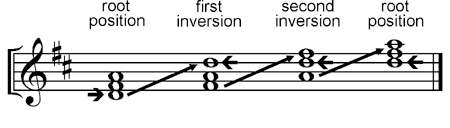
This might not sound very exciting, but broken
chord patterns are the most efficient way of practicing chords and teaching your
eye to see them in the keyboard. There’s even a full broken chord Canon in D piano arrangement – the ideal chord warm-up for any creative keyboard
session.
That's a practice-speed performance - feel free to play as fast as you like!
Left hand accompaniment patterns
The Module Six theory excursion is
optional, but a solid grasp of chord tones – root, third, fifth, octave, tenth
– becomes very useful as soon as you start building left hand Canon in D piano accompaniment
patterns for your Canon performance in Module Eight.
As usual, we simplify things temporarily and build universal root, third, octave, tenth (R–5–8–10) accompaniment patterns with two hands first before graduating to left hand solo performance and adding some of the Module One right hand thirds patterns.
Right hand broken chords
From there, the logical step is to play root, fifth, octave, tenth accompaniments with right hand broken chord patterns. By now, you’re quite used to playing from musical shorthand that leaves you in charge of the actual music-making.
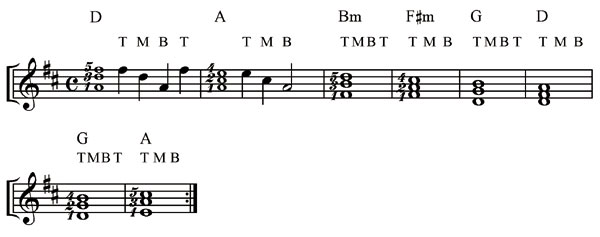
It soon becomes apparent, however, that purely pattern-based arrangements often require slight adaptation (‘tweaking’). Compare the version above with this ‘tweaked’ version.
The order of the left hand chord tones has been changed to fix ‘bald spots’. As a keyboard composer, you need to listen out for where your arrangements need this kind of attention – and have a sufficient grasp of chord theory to find alternatives. By this stage, the Canon Project is offering plenty of ‘audio challenges’ for you to practice these skills.
|
The CANON PROJECT Pachelbel’s Canon in D is perhaps the most famous chord sequence of all time, and the basis of dozens of popular hits. If you can play and understand the Canon chord sequence, there isn’t much in popular music harmony you won’t be able to figure out! Its regular structure also makes it a great springboard for improvising and composition. |
|
Amazon Books also available Udemy
Click through to the Canon Project YouTube playlist here
The root-fifth-octave-tenth patterns you start learning in Module Seven of the Canon Project are instantly transferable to any chord sequence you come across. Your Canon Project course has a set of exercises to help you master these invaluable patterns, and regular visits will ensure you’re never short of accompaniment ideas.
Suspensions
In Module Eleven, attention turns back to the right hand for the introduction of suspensions. About two thirds of the way through any classical recording of the Canon, you will hear something like this.
What is happening is that the middle note of the right hand triads is being pulled up a scale step temporarily and then being released back to its original position.
In music theory, this is called ‘suspension and resolution’. It’s a great way of getting more out of any chord sequence, and a trick every modern keyboard player will want to know.
As usual, the Canon Project walks you through the theory-in-practice so you can apply what you learn to other chord sequences. Here’s a sample drill.
Break up the right
hand ‘sus-res’ figure and rock it over a mixed-type left hand accompaniment,
and you get the performance - the first hint that your Canon in D piano arrangement will get thoroughly modern, down the line!
The module audio challenge offers another rock ‘realisation’ of the new suspensions feature, but in the key of F.
Some arrangements just ‘sound right’ in a certain key, and vocalists can often only sing a song in one key, so transposing into different keys is a fact of life for pro and semi-pro musicians.
Again, Musicarta walks you through the process of transposing the new ‘sus–res’ chord sequence. Whether you’re interested in the theory or not, you’re transposing in practice – and transferring your Canon know-how into other keys.
Rock your Canon!
The introduction of suspension-release into the Canon in D piano performance brings out the modern potential of this timeless chord sequence. See the Canon Rock (mainly guitar) and Keyboard Canon improvisation playlists on YouTube for some rock treatments to inspire your study.
This is the end the second Musicarta Canon Project sample page, which has shown how you will build up to playing the eight right hand triads, and explore their potential over a simple bass line.
The next Sample Page shows how we go on to develop the left hand accompaniment, and put the two together for impressive-sounding two-handed chord textures.
The Musicarta Canon Project is a methodical step-by-step programme for building real, useful keyboard chord skills and understanding. If you’re serious about developing your musical talent, jump in and get with the programme!
|
The CANON PROJECT Pachelbel’s Canon in D is perhaps the most famous chord sequence of all time, and the basis of dozens of popular hits. If you can play and understand the Canon chord sequence, there isn’t much in popular music harmony you won’t be able to figure out! Its regular structure also makes it a great springboard for improvising and composition. |
|
Amazon Books also available Udemy
Click through to the Canon Project YouTube playlist here
Click through to the third Canon in D piano sample page here.
|
OUT NOW! |
THE MUSICARTA BEAT & RHYTHM WORKBOOK At last! An effective approach to keyboard rhythm & syncopation skills. Learn more! |
ONLY $24.95! |


 THE LOGO

THE MUSICARTA
|
The MusicartaA methodical approach to keyboard syncopation for
|
PUBLICATIONS
exciting keyboard
creativity courses
CHORDS 101
WORKBOOK

~HANON~
video course

Musicarta
Patreon
PENTATONICS
WORKBOOK
video course

Creative Keyboard
video course

BEAT AND RHYTHM
WORKBOOK


- Volume 1 -

12-BAR PIANO
STYLES WORKBOOK
MUSICARTA MODES
WORKBOOK
PIANO STYLE
CANON PROJECT
video course
VARIATIONS
video course

- Piano Solo -
video course

- Piano Solo -

YouTube playlists