The Musicarta Canon Project
Canon Piano Chords
The Canon piano chords form the basis for dozens of pop music hits. You can instantly transfer all the work you put into your Canon piano arrangement to other pop-rock and modern-classical music making.
Just landed? This is Sample Content page three for the Musicarta Canon Project on video platforms. Click up to the series home page for orientation, or browse the other Canon Project sample pages via the right-hand navigation table.
Slash chords
Another way of getting more out of your Canon piano chords is to play a note other than the root of the chord with your left hand. In popular music, these chords are known as ‘slash chords’ or ‘slash basses’ because in sheet music they’re written, for example, A/C# – A-slash-C sharp, meaning “An A chord with C sharp in the bass” (say “A over C sharp”).
Slash basses allow the bass line to smooth out, making it much more melodic. Here are the skeleton slash-bass chords.
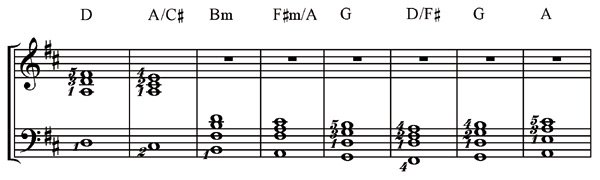
Here is a 'realisation' using this BMT pattern.

Could you have worked that out yourself?
By this stage in the Canon Project, transposing has become a regular module feature. Here’s a slash-bass work-out of the Canon piano chords in G.
Are you starting to hear the chord structure of these wild-card examples? One of the advantages of working on a single chord sequence so intensively is that its harmonic shape and dynamics become apparent to you.
“Better to dig one deep well than ten shallow ones.”
This little Canon chord sequence doesn’t go all the way through the first time – it gets as far as the third chord and then reverses, twice. The last time, it repeats the last two chords.
More chord voicings
With a new bass line, the right hand chords also can undergo some remodelling.
If you play the new chords with octaves in the bass split up bottom, top, top, bottom, you’ll have this grand-sounding version.
A pop-styles keyboard player will want to have the option to play chords in the left hand and a solo in the right. (It’s the typical jazz voicing as well.)
Here, the triads have moved into the left hand.
This example offers another melody to work out by ear. Here’s the working audio clip which helps you identify the basic shape behind the melody.
Transposing challenges are now a routine part of the Canon Project work. Here’s the Module performance in G.
The arrangement sounds better in the new key – precisely why the modern pop-styles keyboard player needs to be able to transpose!
The melody
The Canon chord sequence is ideal for learning to create melodies around chord tones. Because of the Canon piano chords’ regular structure, a bit of melody that fits the first pair of chords will fit the next two pairs as well, and the last pair with a bit of ‘tweaking’.
Module Thirteen also invites you to work on your aural skills. Many people believe that a ‘good ear’ is something you either have or not. In fact, there are tried-and-tested techniques for improving your ability to ‘get’ a melody by ear. Knowing your Canon chords so well will help you make swift progress.
The techniques employed are only available to purchasers of the Canon Project, but listen to these two versions.
Can you hear the slight difference between them? Where the second one goes up instead of going down? You’re already on your way! 'Just listening' like that is exactly how you’ll start working methodically on your ‘playing by ear’ – and with slowed-down, repeating audio files to help.
The tasks described above are advanced, but achievable because they build on what you already know.
The Musicarta Canon Project is obviously not ‘Learn To Play The Piano In Six Easy Lessons’ material, but a professional, progressive multi-level study programme. You can happily skip the theory and still come away with plenty of keyboard riffs and skills in record time. But beware – some of that theory might rub off on you!
Teaching material for these crucial creative keyboard skills is not readily available. If you think the Musicarta Canon Project might be for you, get on board now!
Learn more about Canon piano chords on Sample Page Four.
|
OUT NOW! |
THE MUSICARTA BEAT & RHYTHM WORKBOOK At last! An effective approach to keyboard rhythm & syncopation skills. Learn more! |
ONLY $24.95! |


 THE LOGO

THE MUSICARTA
|
The MusicartaA methodical approach to keyboard syncopation for
|
PUBLICATIONS
exciting keyboard
creativity courses
CHORDS 101
WORKBOOK

~HANON~
video course

Musicarta
Patreon
PENTATONICS
WORKBOOK
video course

Creative Keyboard
video course

BEAT AND RHYTHM
WORKBOOK

- Volume 1 -

12-BAR PIANO
STYLES WORKBOOK
MUSICARTA MODES
WORKBOOK
PIANO STYLE
CANON PROJECT
video course
VARIATIONS
video course
- Piano Solo -
video course
- Piano Solo -
YouTube playlists