CHORD PIANO
A Four-chord Pyramids Version
Chord Piano – A Four-chord Pyramids Version is Lesson Four of The Pyramids Variations, a graded series of free online piano lessons from Musicarta.com. For an overview of the Pyramids Variations series and to get started (you need to have completed Lessons One to Three), click up to the series covering page here. To find more free piano lessons online at Musicarta.com, go to the Musicarta.com home page via the navigation bar on the left. In case you need to revise your progress so far: - In Lesson One, you played the Pyramids chord sequence using just the simplest Basic Music-making Position (BMP) chords.
- In Lesson Two, you added shape to your performance using two-bar left-hand-over patterns.
- In Lesson Three, you added a chord-tone melody.
In Part One of Lesson Four, you’re going to make the Pyramids chord base bigger and much grander-sounding. In Part Two, you’ll put the melody back over this expanded base.
Here is what your Part One lesson performance will sound like: The file named in the right hand cell of the table above is the MIDI file of the performance you will learn in this module. Played on MidiPiano, Musicarta's recommended 'virtual keyboard', it will look-and-sound like this: This text you don’t see If you download and install MidiPiano - it's quick, easy and safe! - you can see what to play and use the application's slow-down, repeat and zoom features to help you learn more quickly.
Part One
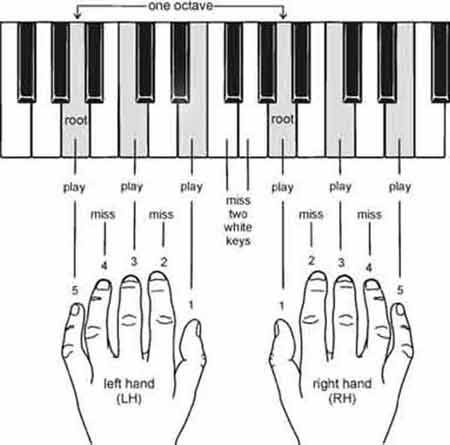
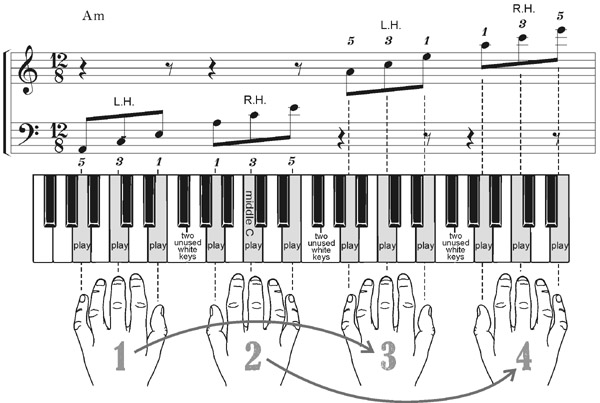
Once you can locate Basic Music-making Position (BMP) chords on the keyboard using their name-note (root) – the lowest note in each hand – you can easily play a grand-sounding version of Pyramids called the Four-chord Version. In the previous versions, you played just two BMP chords (six notes) for each chord symbol in the chord sequence. In the Four-chord Version, you play four BMP chords for each chord symbol, making twelve notes. You start your chords an octave lower than before, so that the right hand now plays middle C. You play a left hand chord (1), a right hand chord (2), a left hand chord (3) and a right hand chord (4) all the way up the keyboard, like this:

With the help of the illustration and the MidiPiano performance, try to copy the audio file and play a four-chord A minor pattern.
The twelve-eight time signature
If we are going to play four BMP chords for each chord symbol, there will be twelve notes instead of six in each bar. The time signature will have to be ‘twelve-eight’, with twelve quavers to the bar.

The music example shows how twelve-eight is counted: “ONE-and-a TWO-and-a THREE-and-a FOUR-and-a…” The notes in twelve-eight come at exactly the same speed as the notes in six-eight, so each bar will last twice as long as it did in the previous six-eight version. The notes do not come twice as quickly just because there are twelve notes in a bar instead of six. Count out aloud “ONE-and-a TWO-and-a THREE-and-a FOUR-and-a…” as you listen to a four-bar Am – F – G – Am chord sequence in twelve-eight.
A sketch of the Four-chord Version
Let’s look at a music sketch of the Four-chord Version:
The 'sketch' music is deliberately printed too small to play from, but you can still see the chord symbols and the bar numbers. The sketch music is there for you to notice some things and to help you understand this module.Here are the audio and MIDI performance files for Part One again.
Pick out these features as you listen and/or watch:- The first half of this version (bars 1 to 8) is on the first page; the second half (bars 9 to 16) is on the second page.
- You can see the chord symbols and the bar numbers clearly.
- For each chord symbol there are four BMP chords. These are the left hand, right hand, left hand, right hand chords, played (mostly) from bottom to top.
- The exception is the two up-and-down LH-over patterns in bars 7 and 8 (bottom line of the first page) and 15 and 16 (bottom line of the second page).
We are going to look more closely at these double-length LH-over patterns next.
The four-chord LH-over patterns
Let's look at the full-size music of the four-chord LH-over patterns. Here's the first one we meet - the double-length E major LH-over pattern in bars 7 and 8, at the end of the first half of the piece.

Try not to start reading the music straight away. Rather sit back tick them off these pattern features as you find them. The E major LH-over pattern in bars 7 and 8 is made up of: - Four chords going up. (You can tell these BMP chords by the beams joining the groups of three notes together.)
- One LH-over note at the very top (E, the name-note of the chord)
- Four chords coming back down, but...
- ...only as far as the middle note of the last chord, to make twelve notes in the bar.
To remind you of the E major BMP chords, here is the two-chord E major LH-over diagram from Lesson One:

You double the 12-note pattern by starting an octave lower and playing four (L, R, L, R) chords before the top left-hand-over note. Then play all the way back down, but just as far as the last middle finger.Try to play the four-chord LH-over pattern in E major, using the audio and MIDI performance files under the written-out music example above. The A minor LH-over ending in bars 15 and 16 is the same shape as the E major pattern but ends half-way down, on a note A

Your Part One performance
See if you can play the sixteen bar Part One Four-Chord Version shown in the sketch music (just the chords - no melody) from the information in this module so far. Here is the Pyramids chord chart with special notes for the four-chord version to help you. (No Introduction is needed for a longer piece like this.)

The music for the Pyramids Four-chord Version is available as a PDF via this link, but try to play the Part One performance from your build up so far. Don't let reading the music take away what you already know./p>
Part Two
In Part Two of Lesson Four, we're going to put the melody back on top of this expanded piano chord base. The Part Two performance will sound like this:
First, here are two ways of making the four-chord foundation more secure.
Because the four rising BMP chords cover so much of the keyboard, it’s quite a big jump at the end of a bar down to the start of the next four chords. It helps to be very sure of your target notes.The notes labelled at the bottom of the keyboard in the following illustration (A, G, F, E and D) are the five notes (the roots) you have to jump back down to from the top note of the previous chord. As soon as your left hand has finished playing the third chord of the four-chord pattern (hand 3 in the first illustration in this module), it should set off to find the next root in the series. Waiting for the right hand to finish chord 4 is unnecessary and causes delays in the music.

The two zigzag lines in the illustration show the bass line – the movement of the roots in the first and second halves of Pyramids. It is a good idea to rehearse this zigzag bass line on its own – it helps you remember where you are in the chord sequence and what your next left hand ‘target’ note is.Look at this sample exercise, and play the audio and/or MIDI files. The music shows the bass line of the first half of Pyramids in the ‘normal’ two-chord position, then that same music an octave lower – where you play it in the four-chord version. Then you see and hear the same thing for the second half of Pyramids.
This is a very effective exercise, worth any amount of ‘trial and error’ practice.
To make the four-chord version sound right, you need to use your piano or keyboard’s ‘sustain’ pedal. You use the sustain pedal to keep important notes sounding that you can’t keep held down with your fingers. The roots of the Pyramids Four-chord Version are a good example, and the Four-chord Version is an ideal place to start learning good pedalling. The main fault in pedalling is to pedal ‘down on the beat’ – at the same instant as you play the first note you want to sustain. This is wrong – you always catch some sound you didn’t want. The correct way to pedal is to push the pedal down just after you have played the first note you want to sustain. This is called ‘pedalling up on the beat’. Be quite clear about this: you actually take your foot off the pedal at the instant you play the note you want to keep (sustain)! Then (and only then), you pedal down to catch the note. It’s quite difficult to learn ‘up on the beat’ pedalling. One good way to practise good pedalling is to say out loud - and in rhythm - what you expect your right foot to do: “UP DOWN-a TWO-and-a THREE-and-a FOUR-and-a...” The 'UP DOWN' indicate how and when your foot moves. Watch your foot to make sure it is actually doing what you’re telling it to do. It’s quite a fast snap-off-and-on of the pedal, but you will miss your bass note if your foot moves any slower. Pedalling is indicated in music in several ways. Sometimes you will see 'Ped' and '*' symbols to show when the pedal is to be depressed and released:

Otherwise, you will find a line with either spikes or gaps in it showing where to pedal:

It’s very easy to pedal too much, overwhelming your listeners and losing your music in a great wash of sound. You must listen carefully to your pedalling and try to be ‘tasteful’.
Playing the melody over the Four-chord Version
The simple 16-bar Pyramids melody can be played right at the top of the four-chord Pyramids version we learned in Part One of this lesson. Here are the performance files of the Part Two performance:
To understand how the performance is put together, we can start from the Lesson Three six-eight ‘Pyramids: Adding the Melody’ version. check off these points in the following diagram: - Everything in the right hand (BMP chord and melody) goes up an octave.
- The left hand starts an octave lower.
This leaves room for two more chords – the right and left hand chords 2 and 3 of the illustration below.

- This leaves room for two more chords – the right and left hand chords 2 and 3 of the illustration below.

Rehearsing the four-chord-with-melody version
When you first added the melody to the chords of the Pyramids First Performance, you rehearsed the zigzag line of the new melody notes against the shape of the roots that you already knew. You saw that the line the tune makes is nearly the mirror image of the shape of the roots. We used this little one-line study:

Now that you’re playing with an extra two octaves and two more BMP chords, it’s a good idea to rehearse again the roots in the left hand and the melody in the right hand, where you actually play them in the four-chord version. Use the next diagram to locate the new melody and bass notes:

Rehearse the zigzag shapes in the new four-chord position using the following study. It shows perfectly how you are ‘making room’ for the two extra chords. The audio and MIDI files are just below the music.

Try to play the melody on top of the Four-chord Version chords. All you have to do is fit the four chords of Part One in between the four-chord version top-and-bottom notes you’ve just played. You definitely need the sustain pedal to hold the top melody notes and roots in this version. Listen carefully to make sure you pedal cleanly, letting all the old notes go and catching the important new one. Here are the performance files again for you to copy:
You can download the music using this link, but unless you read music well, playing the four-chord melody version from the 'non-music' resources in this module will probably be easier.
This is the end of Lesson Four of the Pyramids Variations series of free online piano lessons from Musicarta.com. When you’re ready, go on to Lesson Five, where we develop the melody and make it stand out even more from the chords. Otherwise, take a break and browse the tabs on the Musicarta.com home page for more great ways to make the chord piano approach work for you.
Thank-you for visiting Musicarta.com! Come again soon!
|