MUSIC CHORDS
Find great piano MUSIC CHORDS easily with the
Musicarta Basic Music-making Position
The Musicarta Basic Music-making Position makes finding music chords at the keyboard easy.
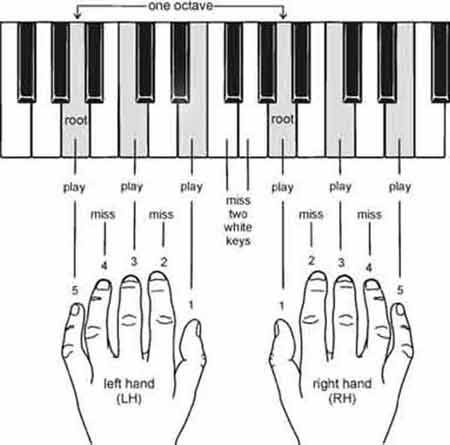
The Musicarta basic music-making position is the basis for the The Pyramids Variations, Musicarta's premium home-study piano lessons course.
|
The PYRAMIDS VARIATIONS Home-study download comprising a 150-page PDF, 200-plus MIDI files of the musical examples and a free ‘virtual keyboard’ MIDI file player. Study online with audio files of all examples and 50-plus how-to videos. A comprehensive creativity booster for every keyboard player. |
|
Click through to the Pyramids Variations YouTube playlist here.
A progressive build-up to guarantee progress
Every lesson in the build-up to the Pyramids Variations Concert Performance adds a little to what went directly before – there are no big surprises and no yawning gaps. The result is that you can build up to an impressive performance much faster than you could with conventional teaching.
Here’s the build-up so far…
In Lesson One of the Pyramids Variations, you learn how to use the Basic Music-making Position to play chords at the keyboard, and how to use chord symbols to find the eight chords in the Pyramids chord sequence. Here’s what your Lesson One performance sounds like:
In Lesson Two, a simple left-hand-over technique adds an introduction and an ending, making this pretty chord study:
'No-one gets left behind!'
Now look how the Pyramids Variations makes sure you can find your easy music chords at the keyboard. This diagram shows the new feature in the Lesson Two performance – the ‘left-hand-over pattern’.
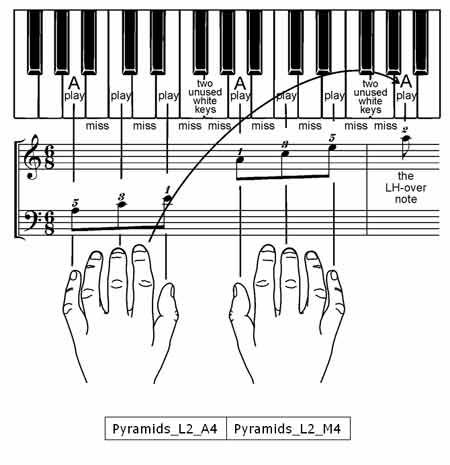
The audio file on the module webpage shows you exactly how the music is supposed to sound.
In the table underneath the illustration, you see the reference number of the accompanying MIDI file. When you play it on the free MidiPiano (Windows OS) virtual keyboard app (included in the download), you will see a finger-by-finger performance you can slow down as much as you like - and set-to repeat!
There's no chance you won't 'get it'!
MIDI support and MidiPiano
The other file number in the table under the illustration – Pyramids_L2_A4 – is the MIDI file for the example.
All the musical examples in the Musicarta Pyramids Variations pdf have MIDI files which you can play on MidiPiano, the Windows ‘virtual keyboard’ included in the Pyramids Variations digital download.
Here’s a video of MidiPiano – with it’s intuitive ‘Piano Roll View’ pane working – playing the MIDI file which demonstrates these ‘left-hand-over’ patterns. See if you can spot four of them.
Watch it on MisterMusicarta YouTube
You see that the Musicarta Pyramids Variations goes all the way to ensure you find your chords and learn how to play them!
|
The PYRAMIDS VARIATIONS Home-study download comprising a 150-page PDF, 200-plus MIDI files of the musical examples and a free ‘virtual keyboard’ MIDI file player. Study online with audio files of all examples and 50-plus how-to videos. A comprehensive creativity booster for every keyboard player. |
|
Click through to the Pyramids Variations YouTube playlist here.
You can continue your exploration of the sample Musicarta Pyramids Variation pages using the links in the series navigation table, right-hand column
Other Music Chords material on Musicarta
Musicarta can make piano chords easy for you in lots of other ways. If you click on the CHORDS tab in the site navbar (left), you’ll find links to fifteen web pages dedicated to giving you a solid understanding of what music chords at the keyboard are – from the simplest to the most complex – and how to build them, practice them and play them.
Popular music is built on chords and the modern keyboard musician must know them inside out! Make Musicarta your regular chord tutor and companion!
|
|
Get an overview of Musicarta in manageable monthly slices – and keep up to date with new postings.
Read all about it on the Musicarta Newsletter page. The Musicarta News - regular encouragement to learn and progress! Or – get the Musicarta RSS feed. [What’s that?] |
|
OUT NOW! |
THE MUSICARTA BEAT & RHYTHM WORKBOOK At last! An effective approach to keyboard rhythm & syncopation skills. Learn more! |
ONLY $24.95! |


PYRAMIDS
|
The MusicartaA methodical approach to keyboard syncopation for
|
PUBLICATIONS
exciting keyboard
creativity courses
CHORDS 101
WORKBOOK

~HANON~
video course

Musicarta
Patreon
PENTATONICS
WORKBOOK
video course

Creative Keyboard
video course

BEAT AND RHYTHM
WORKBOOK

- Volume 1 -

12-BAR PIANO
STYLES WORKBOOK
MUSICARTA MODES
WORKBOOK
PIANO STYLE
CANON PROJECT
video course
VARIATIONS
video course
- Piano Solo -
video course
- Piano Solo -

YouTube playlists