Welcome to Musicarta's
Chord Progression
Explainer Page
What is a chord progression?
This ‘chord progression’ web page is a try-before-buy Musicarta Pyramids Variations sample page, and shows how the Pyramids Variations can boost your ability to simply make music at the keyboard.
Specifically, Lesson Five in the Pyramids Variations build-up to the
Pyramids Concert Performance (YouTube video link) explains the 32-bar AABA chord structure that's at the heart of most jazz standards, and adds some sophisticated seventh chords in the new material.
The page then hosts a more general look at chord progressions and links you through to other relevant material on the Musicarta site.
|
The PYRAMIDS VARIATIONS Building major and minor chords, understanding chord symbols, forming inversions, seventh chords, suspensions and ‘slash chords’, song form, syncopation and anticipation, playing a chord sequence in different rhythms – a practical, hands-on introduction to essential music theory. |
|
Click through to the Pyramids Variations YouTube playlist here.
32-bar AABA form
Up to this point, the Pyramids versions you have played have all been only 16 bars long. To make the piece any longer without simply repeating the same music, we need new material. This new material is the ‘B section’ of the new, extended four-strain ‘AABA’ form.
To make things easy, the keyboard pattern in the new material is mostly the pattern you already know – the six notes of the basic music-making position (BMP) with a melody note on top.
Seventh chords
But the new material is made more interesting by the melody note NOT, in some cases, being one of the BMP notes. This creates three ‘seventh chords’.
See how Musicarta makes sure you don't get lost here!
F major seventh chord (Fmaj7)
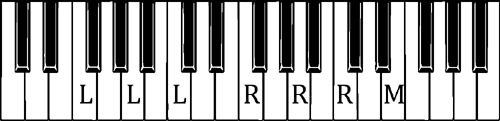
(Key: L = LH note R = RH note M = melody note – also right hand)
(The audio plays all four new 'B section' chords.)
All the Pyramids Variations web-age build-up modules have scrolling MidiPiano-plus-MS (written-out music) videos to help you get familiar with the module performance.
Here is the MidiPiano-plus-MS video of this lesson’s material.
Watch it on MisterMusicarta YouTube
Seventh chords make music sound interesting and generate harmonic movement.
The Pyramids Variations ‘B section’ introduces seventh chords gently into a framework you already know. If you want a more head-on introduction to seventh chords, visit Musicarta’s seventh chords page.
Chord progression and structure
Experienced musicians as well as successful songwriters and keyboard composers take an ‘aerial view’ of chord progressions. They are not stepping through a song chord by chord but seeing the overall picture so they know where they are and where they are going.
Chord progressions in popular music use a number of structures which make them satisfying and make improvising and composing easier. The 32-bar AABA chord progression is one such structure. It forms the basis of most jazz standards and the hits of the 'Great American Songbook'.
Working with the Pyramids Variations material makes understanding chord structure easier. ‘Hearing it for real’ is a big step forward in your popular music education and will prime you to recognise other important chord progression structures.
Now click through to Sample Lesson Seven and see how the new material you introduced in this lesson gets a boost to four-chord performance.
|
The PYRAMIDS VARIATIONS The Musicarta Pyramids Variations aims to exceed expectations by coaching beginners and re-starters to an impressive ‘Concert Performance’ in just eight lessons. After that, you learn a set of variations which model all the contemporary keyboard player’s knowledge and skills. |
|
Click through to the Pyramids Variations YouTube playlist here.
Other chord progression material at Musicarta
Johann Pachelbel’s Canon in D is probably one of the best-loved and most-played chord progressions of all time.
Musicarta’s Canon Project is a Musicarta Publications home-study digital download that will put this beautiful, relaxing music under your fingers in no time.
Click through to the Canon Project home page to take a closer look.
|
The CANON PROJECT Pachelbel’s Canon in D is perhaps the most famous chord sequence of all time, and the basis of dozens of popular hits. If you can play and understand the Canon chord sequence, there isn’t much in popular music harmony you won’t be able to figure out! Its regular structure also makes it a great springboard for improvising and composition. |
|
Chord progressions in popular music use a fairly limited number of chords, which are grouped in keys. If you approach learning these chords methodically, you will quickly find you can play a substantial amount of the pop music repertoire – and tell just by listening what chords are being used.
The Musicarta Chord Progressions series offers that methodical approach – and also coaches you beat-for-beat to a CD-full of keyboard grooves!
|
|
Get an overview of Musicarta in manageable monthly slices, keep up to date with new postings and watch out for discount voucher code.
Sign up for the Musicarta News - regular encouragement to learn and progress! Or – get the Musicarta site RSS feed. [What’s that?] |
|
OUT NOW! |
THE MUSICARTA BEAT & RHYTHM WORKBOOK At last! An effective approach to keyboard rhythm & syncopation skills. Learn more! |
ONLY $24.95! |


PYRAMIDS
|
The MusicartaA methodical approach to keyboard syncopation for
|
PUBLICATIONS
exciting keyboard
creativity courses
CHORDS 101
WORKBOOK

~HANON~
video course

Musicarta
Patreon
PENTATONICS
WORKBOOK
video course

Creative Keyboard
video course

BEAT AND RHYTHM
WORKBOOK

- Volume 1 -

12-BAR PIANO
STYLES WORKBOOK
MUSICARTA MODES
WORKBOOK
PIANO STYLE
CANON PROJECT
video course
VARIATIONS
video course
- Piano Solo -
video course
- Piano Solo -
YouTube playlists