Patreon MUSICARTA Premium
Finding Inversions
Finding the chords you need on the keyboard quickly takes practice. Here are some tried and tested methods that will definitely help. With easy-to-follow instructions, learners of any age-and-stage can learn and practice them, and teachers can use them with their pupils.
This Musicarta module - "Keyboard Chords – Finding Inversions" - now has MIDI support. You can download the MIDI files for it using this link.
The zipped folder of MIDI files is called Inversion Method MIDI 1. Save the folder to your desktop and ‘unzip’ it. Put the unzipped folder in your Musicarta MIDI folder and tidy up. If you are not familiar with zipped folders, the Musicarta MidiPiano download page has full instructions. It’s simple!
You can play the MIDI files on MidiPiano, Musicarta’s recommended virtual keyboard. The number, e.g. InvMeth_1, in the right hand table cell under each musical example tells you which MIDI file to play. MIDI files are tiny – downloading will use next to nothing of your bandwidth.
If you have not already downloaded MidiPiano, DO SO NOW! Downloading is simple and safe and the application is small, FREE and easy to use. Use the MIDI PIANO tab on the navbar, left or follow the link to go to the Musicarta MidiPiano download page, which will tell you all you need to know. Take it all the way – today! MidiPiano is a great addition to your learning resources. You'll soon get used to using it and come to find it invaluable.
BEFORE we get to the keyboard chords inversions material, a quick announcement
Thank-you! Find out more about Musicarta home study downloads in the right hand column and at the end of the page.
Before we get to the keyboard chords inversions material, a quick announcement...
|
MUSICARTA EASY The Musicarta Easy Piano Style shows you how to get your hands on the keys and start making music right away! With lots of graphics, full audio and MIDI support and all the solos on Mister Musicarta YouTube, you’re sure to get some beautiful pieces into your repertoire quickly – and learn how to find the music in the keyboard for yourself. |
|
Click through to the MEPS YouTube playlist here
Thank you! Find out more about Musicarta home study downloads in the right hand column and at the end of the page.
Inverting chords
When you’re just starting, the difficulty with learning inversions is that you lose sight of the keys when you take your hand off to move. The Musicarta method overcomes this initial problem by using two hands – to start with. Make sure you follow the two-hand instructions exactly to get the full benefit.
We will be using the chord tones of C major, shown here (shaded) on a keyboard.
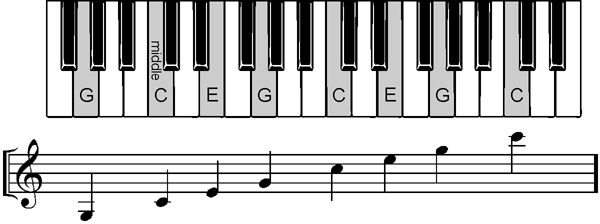
| InvMeth_1 |
There are three steps in this method, which repeat.
1. Start with a simple C major triad in root position. The right hand plays, using fingers 1, 3, 5. Hold the notes down.
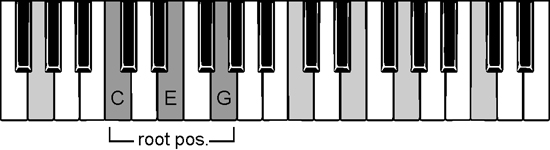
| InvMeth_2 |
2. Repeat the thumb note. It’s a white-key C. Take just that one note off, but play and hold the next C up the keyboard with your left hand. (Any finger will do.)
You will know you have found the right note because it will look and sound the same as the bottom note you just played.
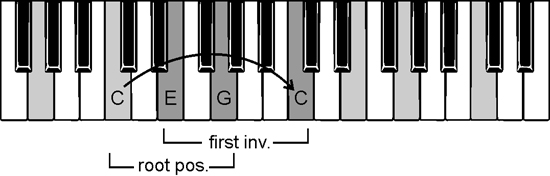
| InvMeth_3 |
3. Next, you take those three notes over with your right hand using fingers 1, 2, 5. The bottom note has gone up an octave: the root position chord has ‘inverted’ into a first inversion chord. Play the first inversion chord with your right hand.
| InvMeth_4 |
The next audio clip covers Steps 1, 2 and 3 all rolled into one:
| InvMeth_5 |
Repeat steps 1, 2, 3 to climb up from the first inversion chord to the second inversion chord.
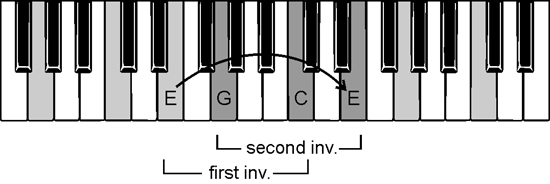
| InvMeth_6 |
Repeat the three steps to climb up from the second inversion chord to the root position chord, an octave above where you started.
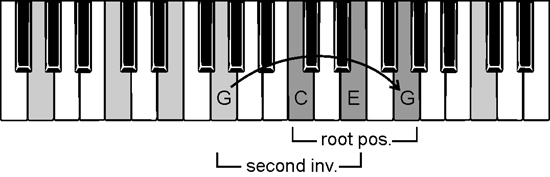
| InvMeth_7 |
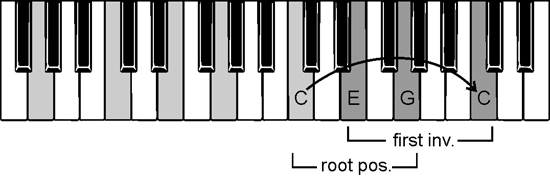
| InvMeth_8 |
This is what you’ve done:
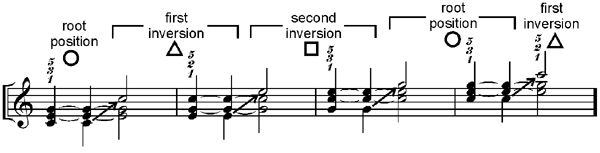
| InvMeth_9 |
Inversions descending
To come down, you start from the top first inversion chord using RH fingers 1, 2, 5.
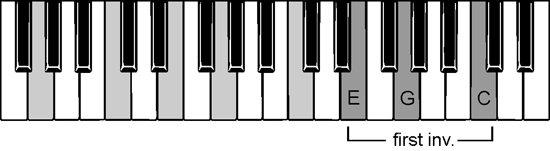
There are three steps to each downward flip.
1. Play your highest first inversion C chord with RH fingers 1, 2, 5 (above). Hold the notes down.
(The audio clip - for all three steps - is below.)
2. Exchange the top note (C, RH5) for the next C down the keyboard – played with your left hand. (Any finger will do.) You should now be holding three notes – two in the right hand (1, 2) and the one left-hand note.
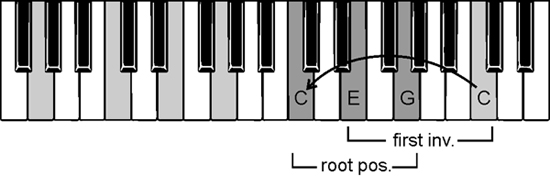
3. Next, you take those three notes over with your right hand using fingers 1, 3, 5. The top note has gone down an octave: the first inversion position chord has ‘flipped’ down into a root position chord. Play the root position chord with your right hand.
(The audio clip is for all three steps.)
| InvMeth_10 |
Continue the three-step process until you get back down to the starting root position chord.
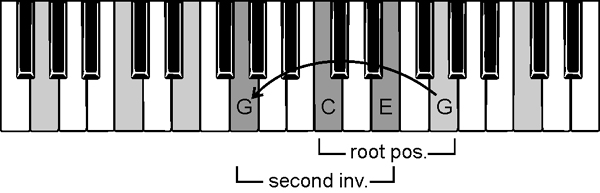
| InvMeth_11 |
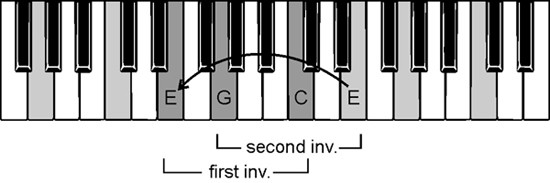
| InvMeth_12 |
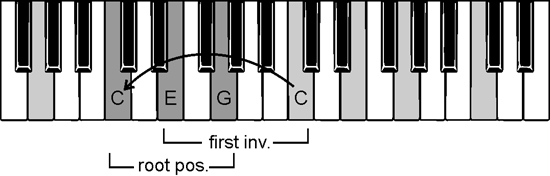
| InvMeth_13 |
This is what the whole downward movement looks and sounds like:
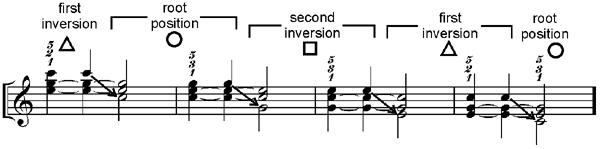
| InvMeth_14 |
You can see in this diagram how the inversions we have used in this exercise overlap.
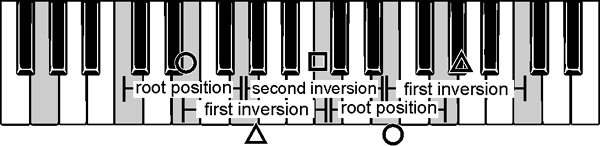
Recap your motivation
To make an inversion, one of the outside notes of a triad jumps an octave over the other two notes, which stay the same.
Root position chords – the ones we usually learn first and can usually always find – are not the nicest-sounding chords. First inversion chords, with the root at the top, are a lot more useful. Second inversion chords, with the third at the top, sound much nicer.
It’s annoying being sent back to First Grade, but using this ‘baby’ two-hand method will teach you to locate your inversions without mistakes and without stress far faster than trial and error and ‘just hoping’.
Putting it into practice
The Musicarta Keyboard Chord Generator shows you how to find all the major and minor keyboard chords. Open the visual Chord Generator file to do the following exercises and go to the Chord Generator page for an explanation and more ways of getting the most out of this great tool.
1. Four flips up and down
Repeat the pattern exactly as you played it here from any Group One root position (circles) chord in the Chord Generator. The following audio file plays the pattern in A minor, then continuously in G major. Practice until you can play along.
| InvMeth_15 |
2. One flip up, one flip down
Play the root position chord (circles) and flip the chord upwards into first inversion (triangles) and downwards into second inversion (squares) using the two-handed method you’ve just learned.
| InvMeth_16 |
You’re trying to become as sure about the octave jump and as slick in taking over the three notes with the right hand as possible.
Make sure you repeat to yourself over and over what chord it is you’re rehearsing as you do these exercises. That way you tie the sight of the keys to the chord’s name in your head.
3. Repeat the above exercises with Group Two chords, and so on. Start from any inversion – circles, squares or triangles. The following audio file plays ‘Four flips up and down’ from root position (circles) in D major, then in C minor. Practice until you can play along.
| InvMeth_17 |
Moving forward from here
Your next step is practicing finding the inversions using just the right hand. Click through to Keyboard Chords - Finding Inversions 2 (module in preparation) for a methodical approach that's bound to produce results.
Then there's a brain-twister called 'Three Chord Tones in Three Places' (Keyboard Chords - Finding Inversions 3 - click through here) which will help you recognize those inversions inside out, back to front and upside down! Get some perspective on what it's like to really see the chords in the keys! Click through and bookmark it for your next study session.
Keyboard chords – Finding Inversions is a Musicarta.com web page. To explore similar keyboard chords explanations and exercises, click up to the Musicarta Chords Division home page.
If you are not already familiar with Musicarta.com, please visit our home page for an overview of how the site can help you develop your musical gifts.
New Musicarta material is constantly becoming available. The What's new? tab on the navbar left will bring you up to date with revisions and new modules. You can subscribe to an RSS feed there, too.
Musicarta has released three digital home study work-books, designed to boost your creative keyboard skills and teach you a host of ready-to-roll keyboard licks and textures.
We present:
|
KEY CHORDS Vol. 1 Musicarta Key Chords builds your chord vocabulary by introducing the chords you are most likely to come across in any song. You practice the chord changes in contemporary riffs (drum backing tracks are included), with easy step-by-step rhythmic build-up of impressive keyboard syncopation. |
|
|
The CANON PROJECT Pachelbel’s Canon in D is perhaps the most famous chord sequence of all time, and the basis of dozens of popular hits. If you can play and understand the Canon chord sequence there isn’t much in popular music harmony you won’t be able to figure out. Its regular structure also make it a great springboard for improvising and composition. |
|
|
The PYRAMIDS VARIATIONS The Musicarta Pyramids Variations aims to exceed expectations by coaching beginners and re-starters to an impressive ‘Concert Performance’ in just eight lessons. After that, you learn a set of variations which model all the contemporary keyboard player’s knowledge and skills. |
|
Check out the sample content via the 'Learn more' links, and see the title playlists at Mister Musicarta YouTube.
|
|
Get an overview of Musicarta in manageable monthly slices – and keep up to date with new postings.
Read all about it on the Musicarta Newsletter page. The Musicarta News - regular encouragement to learn and progress! Or – get the Musicarta RSS feed. [What’s that?] |
Thanks for visiting MUSICARTA! Come back soon!
|
|
|
|
|
OUT NOW! |
THE MUSICARTA BEAT & RHYTHM WORKBOOK At last! An effective approach to keyboard rhythm & syncopation skills. Learn more! |
ONLY $24.95! |


PATREON |
The MusicartaA methodical approach to keyboard syncopation for
|
PUBLICATIONS
exciting keyboard
creativity courses
CHORDS 101
WORKBOOK

~HANON~
video course

Musicarta
Patreon
PENTATONICS
WORKBOOK
video course

Creative Keyboard
video course

BEAT AND RHYTHM
WORKBOOK

- Volume 1 -

12-BAR PIANO
STYLES WORKBOOK
MUSICARTA MODES
WORKBOOK
PIANO STYLE
CANON PROJECT
video course
VARIATIONS
video course
- Piano Solo -
video course

- Piano Solo -

YouTube playlists